Global SWF Special Feature (Oct'26): ADGM
1st October, 2026In the past ten years, Abu Dhabi has evolved into a global financial powerhouse, supported by the massive sovereign wealth of the emirate, and evidenced by the number and caliber of companies establishing a presence in the city’s free zone. The September 2026 edition of the Global Financial Centers Index (published by Z/Yen and China’s CDI) ranked Abu Dhabi at 13th place globally, up from 21st place in 2025.
A significant part of the credit must be attributed to Abu Dhabi Global Market (ADGM), which opened in 2015 and started changing the tone and the dynamics of the emirate. Starting from scattered pools of capital and low-profile finances, ADGM pushed for a unified discourse and a pro-active approach to attract inbound foreign capital based on the existing wealth, coining the terms the Falcon Economy, and the Capital of Capital.
In an update published in September 2026, ADGM confirmed that the assets managed by the firms operating in the free zone grew by 54% in the past 12 months and by US$ 2.1 trillion in the past six months, implying a current AuM of about US$ 10 trillion by the 190 fund and asset managers based in ADGM. Despite the ongoing Iran War and the disruption it has created across the Gulf, ADGM registered 84 new firms in the first nine months of 2026 and if the current pace continues, 2026 will mark a new maximum with 112 registrations. The combined workforce across Al Maryah Island and Al Reem Island grew 34% year-on-year to 49,027 professionals, and the investment in AI by ADGM entities surpassed US$ 100 billion, anchored by MGX.
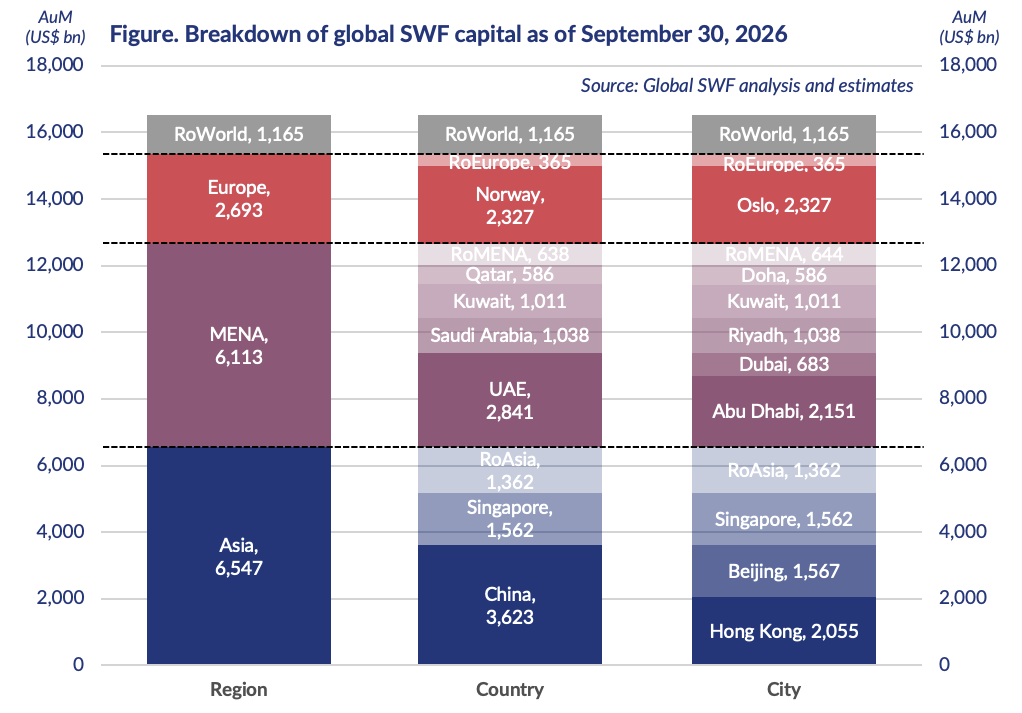
2026 World City Ranking (Global SWF):
In 2024, Global SWF published for the first time, a ranking of the World’s Wealthiest Cities in terms of SWF capital. Abu Dhabi maintained its lead in both 2024 and 2025 ahead of Oslo and Beijing, thanks to the number of SWF institutions operating from the capital of the UAE. In 2026, Oslo took over from Abu Dhabi to become #1, thanks to the significant performance of NBIM (the world’s largest SWF) in the past two years.
The Abu Dhabi SWFs cover a wealth of mandates, investment strategies and risk appetites. Today, the emirate operates three major SWFs: ADIA, which is the flagship savings and stabilization fund; Mubadala, which includes subsidiaries such as ADIC, Mubadala Capital and MGX; and L’IMAD, which took over ADQ earlier this year. In addition, there are three entities acting as quasi-SWFs: ADFD, which manages a small investment portfolio; EDGE, which focuses on national security and military investments; and XRG, which invests in Oil & Gas globally. Lastly, the EIA is a federal SWF but it is headquartered in Abu Dhabi and chaired by an Al Nahyan, so we consider it part of Abu Dhabi Inc. We estimate these seven SWFs manage US$ 2.2 trilion.
Abu Dhabi is also home to significant wealth held in Royal Family Offices (RFOs), which can be seen acting as quasi-SWFs often. The most important of them all is Fount Trust (Royal Group), and its subsidiaries including 2PointZero, Judan, IHC, Alpha Dhabi, Lunate, or G42. We count over 20 private offices chaired and/or owned by Al Nahyan family members, which would add US$ 0.6 trillion to the total, placing Abu Dhabi ahead of Oslo once again.
The emirate’s SWFs and RFOs deployed US$ 61 billion in 117 different transactions during the first three quarters of 2026 . As of September 30, 2026, these funds employed c.4,000 staff, making Abu Dhabi not only one of the world's financial capitals but also human capitals when it comes to SWFs.