Fund of the Month (Apr'26): Samruk-Kazyna
1st April, 2026The Republic of Kazakhstan has four major Sovereign Wealth Funds: the National Fund (NF), the National Investment Corporation (NIC), which operate under the central bank the National Bank of Kazakhstan (NBK), Samruk-Kazyna JSC (SK), and Baiterek NIH JSC, a state development holding focused on the banking sector.
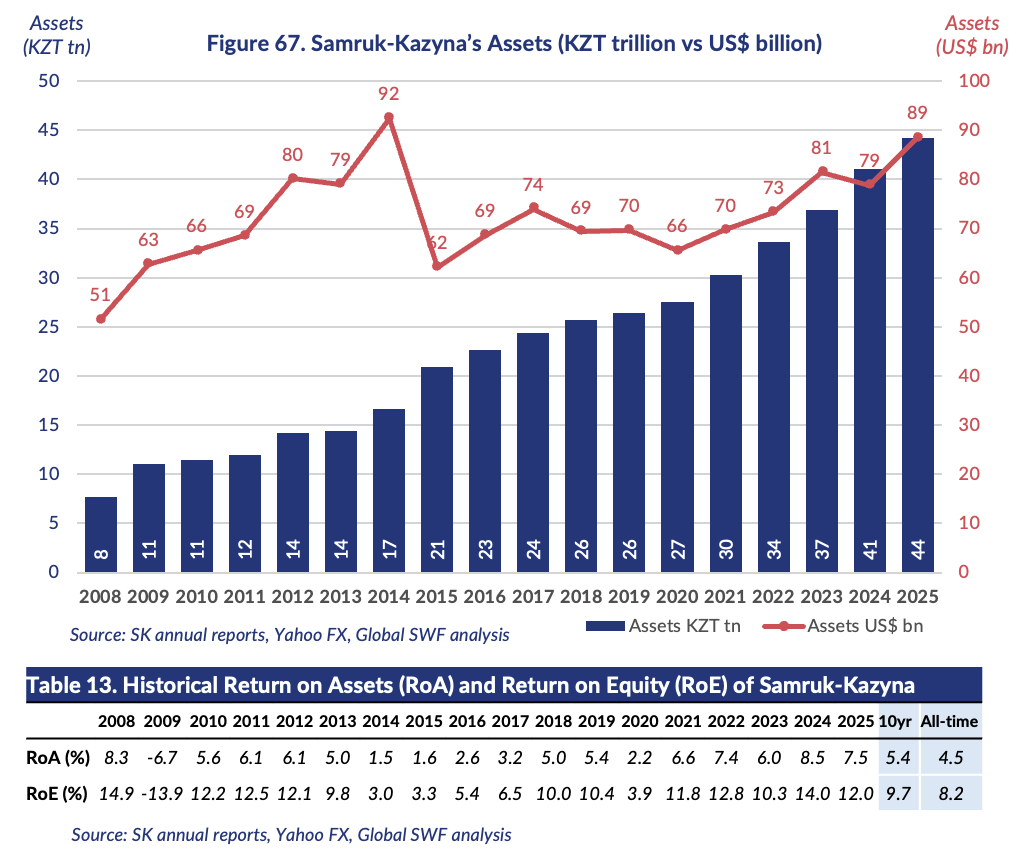
Samruk-Kazyna was formed in 2008 as the merger of “Samruk” and “Kazyna” by decree of the President of the Republic of Kazakhstan to ensure economic stability amidst the global financial crisis. Today, the fund is among the world’s 25 largest SWFs with assets under management of US$ 88.6 billion as of December 31, 2025 and is a key tool of industrial policy that manages some of the country’s largest state-owned assets.
Samruk-Kazyna’s sole shareholder is the Government of Kazakhstan and its Chairman is the country’s Prime Minister, Olzhas Bektenov. The other seven members of the Board include the CEO of UAE’s Masdar, and an AI member (SKAI). The fund employs 124 staff at holding level and 257,317 personnel at group level.
In 2023, the government approved the 2023-2032 Development Plan, which aligns the activities and goals of Samruk-Kazyna with those of the Kazakhstan-2050 strategy. Such strategic objectives include increasing the net asset value through effective management, attracting FDI, developing competition by continuing to pursue privatizations and IPOs, and implementing strong corporate governance and sustainable development.
[GSWF] Samruk-Kazyna was established in 2006/08 as an investment holding of some of Kazakhstan’s most important assets. How would you say the fund has evolved and changed for the past 18 years?
[SK] Samruk-Kazyna was established in 2008 as the merger of two holding companies in response to the need to stabilize the national economy during the global financial crisis. The objective was successfully achieved with the Fund playing a significant role in stabilizing the banking sector and refinancing mortgage loans. Following its exit from financial institutions, the Fund embarked on a new objective, enhancing the efficiency of asset management. This marked the beginning of a comprehensive transformation program, with key priorities in strengthening corporate governance, increasing the profitability of portfolio companies and ensuring financial sustainability.
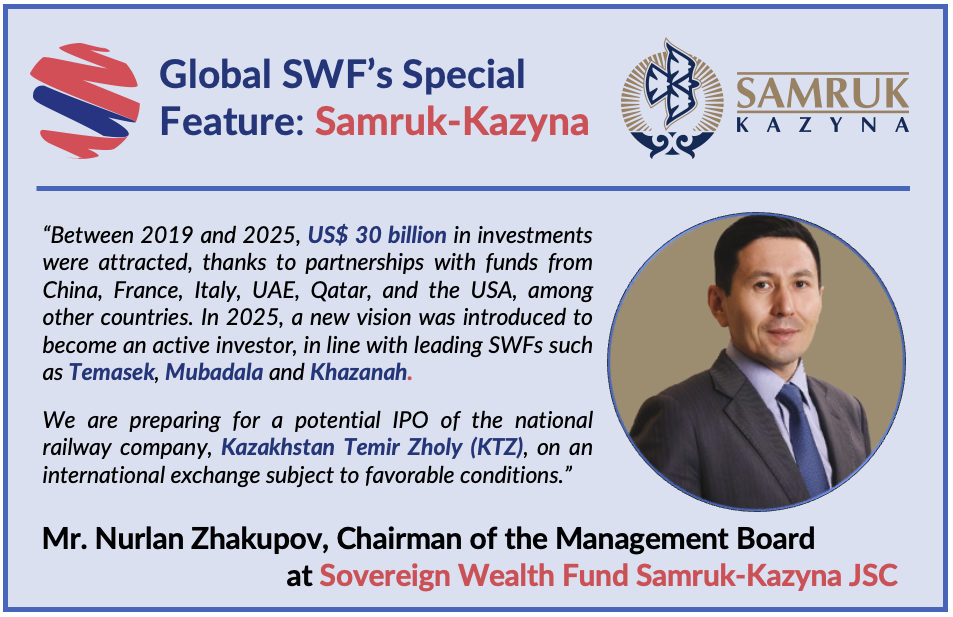
In 2018-2020, the Fund set a strategic objective to reduce the stakes shared in the economy. It launched an active privatization and divestment program. However, the global crisis of 2020 triggered by the COVID-19 pandemic and the subsequent decline in oil prices reduced the attractiveness of assets stated for privatization and the IPO timeline was revised. Following the crisis, the primary focus shifted to improving the operational efficiency of assets, advancing privatization initiatives, developing infrastructure and replenishing the resource base. In 2025, a new development vision was introduced, transitioning to strategic holding model and becoming an active investor. As of today, the fund is implementing this model in line with leading SWFs such as Temasek, Mubadala and Khazanah.
As of December 2025, the Fund’s assets reached US$ 88 billion, reflecting an annual growth of 9.3% and a 34% increase compared to 2022. Between 2019 and 2025, US$ 30 billion in investments were attracted, thanks to strong and sustainable partnerships with leading investors from China, France, Italy, UAE, Qatar, and the USA, among other countries. We are currently placing strong emphasis on and actively advancing the implementation of investment projects across three key priority areas: transportation and logistics, digitalization, and energy.
[GSWF] The fund’s total assets as of December 31, 2025, were US$ 88 billion, up from US$ 30.3 billion 10 years ago. Has this growth been organic (larger assets) or inorganic (transfers from the government)?
[SK] The growth was driven by implementation of the investment projects and an increase in net profit. There have been no substantial capital injections from the government. On the contrary, the Fund has effectively acted as a net contributor to the state budget, transferring more than it has received. Last year, the payments made by the fund to the state amounted to over US$ 1 billion. And if you add the taxes that we paid as a group of companies, the total revenues of the country’s budget that come from Samruk Kazyna amount to 19%. In short, it has been organic growth: there were no injections from the government, and we have increased our assets under management by enhancing our operational activities and by expanding our production capacities, we have increased our AuM.
[GSWF] In the decade from 2015 to 2024, Samruk generated an annualized return on equity of 8.8% in local currency. Do you think such high performance will be sustainable in the future?
[SK] The past decade was marked by several significant external factors that negatively affected financial performance. Among them were COVID-19 pandemic and the geopolitical instability of the past 3-4 years. Despite these challenges, the fund’s profitability has remained at a consistently solid level. Looking ahead, the previous ten years have demonstrated high volatility of global environment, and we are not immune to potential large-scale disruptions in future. Nevertheless, the fund remains firmly committed to achieving strong financial results and has the necessary tools and strategic capacity to maintain sustainable level of returns over the long term.
[GSWF] Can you please shed a light on the privatization program, and how many of Samruk-Kazyna’s portfolio companies have been listed so far? Are you currently working on any additional IPO?
[SK] Samruk-Kazyna is consistently implementing its privatization program and supporting the listing of its largest portfolio companies on equity markets. Today, shares of seven companies within the group: KazakhTelecom (1997), KazTransOil (2012), KEGOC (2014), KazAtomProm (2018), Kcell (2020), KazMunayGas (2022), and Air Astana (2024) are traded on various exchanges both domestic KASE, AIX and international London Stock Exchange. Their combined market capitalization exceeds US$ 56 billion reflecting a 124% increase since their respective IPOs.
Currently, we are preparing for a potential public offering of the national railway company, Kazakhstan Temir Zholy (KTZ), which is 100% owned by the fund, on an international exchange subject to favorable market conditions.
[GSWF] Three months ago, Fitch affirmed Samruk’s rating at BBB, Outlook Stable despite an estimated leverage of US$ 20 billion. What is your debt strategy and are you planning more bonds this year?
[SK] Although the fund’s consolidated total debt is estimated at approximately US$ 20 billion, its leverage remains conservative and prudent. The key ratios reflect a strong financial position: Debt / Equity (0.3x), Debt / EBITDA (1.72x), and Net Debt / EBITDA (1.1x). These indicators are aligned with the leverage metrics of peer SWFs that carry similar or even higher credit ratings. Underscoring the prudence and resilience of our financial policy, our debt strategy is pragmatic and project oriented: net borrowings are primarily linked to the implementation of large-scale projects with structures aligned to long-term cash flow generation and keep headroom within our leverage targets. Preserving financial resilience and balance sheet flexibility remains a priority. As for additional bond issuances, we continuously assess market conditions and funding requirements and remain open to capital markets transactions where timing, pricing and rationale are compelling and consistent with our medium-term finding framework.
[GSWF] Can you shed a light on Samruk-Kazyna Invest and its FDI mission? What is your ideal partner? Do you also expect for Samruk-Kazyna to invest out of Kazakhstan in the future?
[SK] Samruk-Kazyna Invest serves as a dedicated co-investment platform within the fund focused on attracting strategic foreign investment into Kazakhstan. Its mandate is pragmatic to partner with strong investors in building new industrial capacities and support projects through development and early scaling until they reach maturity. Rather than acting as a long-term owner, the platform focuses on the most value creating stages of the investment cycle, structuring launch and expansion, and helping to mitigate execution risks. Our investments are aligned with Kazakhstan’s long-term priorities with a clear focus on industrial capacity, technology and competitiveness.
We seek strategic long-term partners committed to building meaningful industrial presence in Kazakhstan with relevant experience in industry and sectors. Capital is important but capability is decisive. We prioritize partners who bring technology, operational excellence and access to global markets and who are prepared to localize production, develop supply chains and invest in workforce development. In essence, we look for partners who view Kazakhstan not only as a market but as a platform for sustained industrial growth.
Samruk-Kazyna’s primary mandate remains domestic. However, selective outward investments may be considered where they serve national interests and where it makes sense from commercial and economic perspective. Whether by securing critical technologies, supporting the international expansion of our companies or strengthening integration into global value chains, such investments would complement, not replace our domestic focus. Their purpose is to strengthen Kazakhstan’s long term economic positioning and strategic resilience.
[GSWF] Our recent GSR scoreboard highlighted the great efforts of Samruk-Kazyna on the Sustainability side, with a 9/10 score – can you please summarize the ESG initiatives of the fund?
[SK] In line with our national objectives, Kazakhstan has joined the Carbon Emissions Neutrality Initiative and pledged to reduce carbon emissions by 15% by 2030, and to be carbon neutral by 2060. Samruk-Kazyna is accountable for 15% of total CO2 emissions in our country, and we have set a strategic goal to reduce our carbon footprint by 10% by 2032, based on the 2021 baseline. Our long-term ambition is for the Fund and its portfolio companies to achieve carbon neutrality by 2060. Aligning with the common country objective, the Fund emphasizes a gradual transition to low carbon technologies without completely abandoning traditional energy sources. There should be a reasonable balance between energy and environmental security while maintaining social stability.
Samruk-Kazyna is actively developing renewable energy in Kazakhstan. Our portfolio company Samruk-Energy converts existing coal fired power plants to natural gas to reduce harmful emissions and installing modern filters on coal stations. Around 6GW of renewable energy projects are carried out in collaboration with Total, Masdar, China Power International Holding, and other investors. We are placing strong emphasis on unlocking Kazakhstan’s hydropower potential through large hydro and pump storage projects with the combined capacity exceeding 2GW.
On top of that, ESG is fully integrated into our corporate governance framework, and when forming Boards of Directors, we can see the requirements for independency, gender balance and expertise in sustainable development. ESG metrics are also embedded into our strategic KPI’s and management performance evaluations. The Fund implements a comprehensive set of social initiatives, providing annual assistance to over one million citizens. Our priority areas include building an inclusive society and supporting healthcare, education, sports and culture
[GSWF] In 2022, the fund went through a massive restructuring, slimming its personnel size from 248 to 124 overnight and closing its representative offices. What was the rationale, and what is the status now?
[SK] Reducing staff is part of funds reform process, and we have focused on improving efficiency of organizational structure and enhancing management processes. Currently, the Fund has a total staff of 124 employees, and we are able to operate effectively with the introduction of new practices. We are always improving and developing, as we want to be better today than we were yesterday, and we want to be better tomorrow than we are today.
In January 2022, Samruk-Kazyna streamlined its international presence in order to enhance overall efficiency. That said, the Fund continuously reviews its engagement formats, and the Beijing representative office resumed its operations in late 2024 to support investment inflows and further expand economic cooperation with China. As Co-Chair of the Kazakhstan-China Business Council, the Fund observes growing interest from Chinese partners in joint initiatives, highlighting the importance of our presence in Beijing. Against the backdrop of increasing competition for Chinese investments, maintaining an office in Beijing is considered strategically important. The Fund will continue to adapt its footprint where it adds tangible value to partnership development and project implementation.
[GSWF] Personally, you have been in the CEO position for three years now. How do you compare it with your previous career in Banking, and what are your goals for the next three to five years at Samruk?
[SK] Over the past three years as Chairman, my professional focus has shifted considerably. Working at the Fund is primarily about strategic management of asset value, development of portfolio companies and building a long-term investment ecosystem. The Fund's core objectives remain consistent to increase the long-term value of portfolio companies and to strengthen the Fund's role as a catalyst for foreign direct investment and as an effective platform for co-investment. In 2026 and beyond, our priority will be continued growth of assets. Under management, we plan to implement several major infrastructure and industrial projects. Looking ahead to 2026-2030, we aim to attract an additional US$ 27 billion, expanding our pool of international partners and investment instruments.
Operational efficiency is also a key focus. We are enhancing our procurement system and driving a systematic digital transformation. Currently, 62 initiatives using AI in production and technological management are underway. Over the next two years, we plan to move forward a model in which 70% of managerial decisions are made with AI. Looking ahead to the next 3-5 years, our goal is not only to achieve quantitative growth, but also to strengthen the sustainability, technological sophistication, and overall investment attractiveness of the entire portfolio.